

Blog
Get Pay Right on ADP Workforce Now® Next Gen™
Bringing trusted compensation intelligence and seamless planning to even more ADP users.
Written by Salary.com Staff
April 10, 2026

Median pay plays a big role in the world of compensation. It reflects the middle salary figure among a group of workers. Median pay is an important number that provides insights into market rates. It is well-understood by professionals in the field.
As human resources grows more complex, median pay provides a helpful metric. This guide explores median pay’s meaning for HR and compensation pros.
Median pay reflects the salary figure that sits at the midpoint of a group’s earnings. Median salary is the middle value that divides a group so half earn above and half earn below that amount. It is a benchmark figure to get insights into the typical earnings of a group. Many compensation pros rely on this figure to set fair wages.
Calculating median salary involves sorting a group’s earnings and then picking the middle figure. If there is an even number of values, the median is the average of the two middle figures. This simple calculation works well with jobs where salary varies a lot between people.
With the help of the Market Pricing tool, organizations can streamline job pricing using HR-reported data, apply location-based adjustments and hybrid composites for pay equity audits, and more accurately benchmark median pay to set fair wages.
Median pay and average salary both provide insights into typical earnings but use different calculations. These differences produce different results.
Aspect |
Median pay |
Average salary |
|---|---|---|
Calculation |
Sorted data and middle value (or average of two middle values if even number) |
Sum of all values divided by number of values |
Impact of Outliers |
Not affected by very high or low salaries, so it shows a typical earning level. |
Pulled up or down by extreme values, like big bonuses for top roles. |
Use in Compensation |
Preferred for fair benchmarking since it reflects the middle of the market. |
Good for total cost views but can mislead if pay gaps are wide. |
Example |
In a group of five salaries: $40k, $50k, $60k, $70k, $200k; median is $60k. |
Same group: average is $84k, higher due to the $200k outlier. |
Compensation teams like median salary because it gives a steady view of market rates without distortion from extremes.
Median salary reflects typical pay and helps compensation teams set ranges that are fair. Using median data means that teams avoid bias from outliers in their data sets.
Median salary reflects typical earnings so compensation teams get better insights. These insights help with discussions about budgets with company leaders.
Median salary highlights typical pay differences among groups of workers (job roles, location). Using median salary helps compensation teams get better insights so they can close gaps in a timely manner.
Using median data helps compensation teams avoid distortions by outliers. This ensures company pay levels match market rates.
Median salary plays a big role in checking how a company's salaries stack up against the market.
Using median salary data helps compensation teams spot pay levels that are below market standards. Without this data, companies risk losing their top talent over time.
Using median salary data allows compensation teams to build well-structured compensation systems. This ensures that employees remain satisfied with their pay levels.
Market rates change rapidly but using median salary data allows compensation teams to stay competitive in job markets across sectors.
Using median salary data ensures that team members receive similar value for their contributions to company success.
To calculate median salary, gather a list of earnings and follow simple steps.
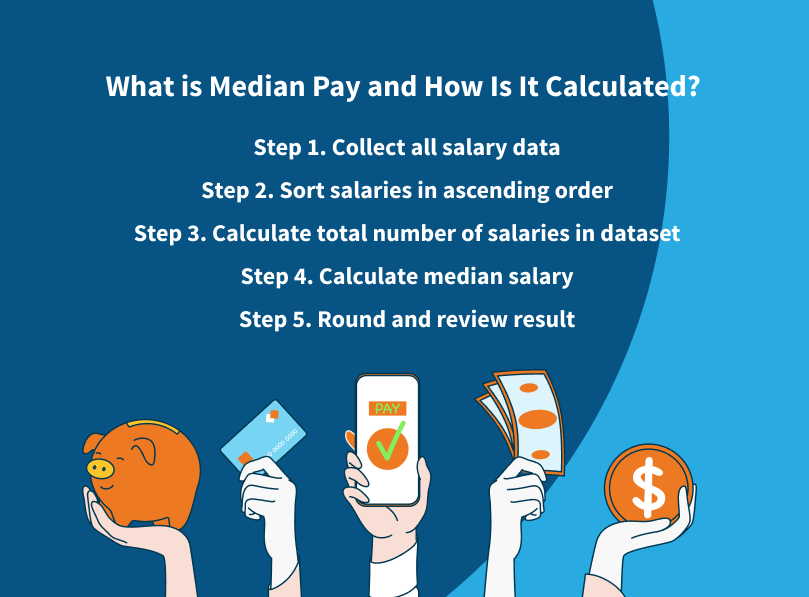
The first step is to gather all relevant salary data from your team or job group. The quality of this step impacts all future steps.
Next, place all salaries in order from lowest to highest value.
Count how many salary figures you have for your group. This number impacts your calculations.
Pick the middle value (or average of two middle values if even number) as the median value.
Round your result to nearest whole number and review it carefully. Make sure the figure makes sense compared to the range of salaries in your dataset.
Key sources provide reliable median salary info for accurate benchmarking.
Reports from government agencies provide broad data on wages in jobs across geographic areas.
Surveys from private organizations provide detailed insights on wages within specific industries.
Most online wage analysis providers pull together data from government and private surveys for comprehensive insights
Check for these reports periodically as they shed new light on trends in wage earning
The U.S. Bureau of Labor Statistics (BLS) provides trusted insights into median wages through surveys and reports.
It covers many jobs with yearly updates on median earnings to keep information current for users.
Data includes breakdowns by state and metro areas for local views that aid in regional planning.
BLS tools help compare median salary over time for trend spotting and long-term strategy development
Free access makes it easy for teams to use in planning without additional costs or barriers.
These reports provide more focused insights into wages within specific fields.
Surveys from groups like WorldatWork show current pay trends that reflect real-time market conditions.
Providers like Salary.com give users custom tools to analyze wages including median values for their unique needs
These providers include detailed 2026 forecasts on wage increases tied to median wage levels
Private data helps with niche roles not covered in broad reports, ensuring comprehensive coverage.
Median pay helps check if earnings are fair across groups in a company.
It spots differences in pay for similar work among various employee groups to highlight potential issues.
Using median supports audits to fix unfair gaps quickly and maintain a balanced workplace.
It ties into laws that require equal pay for equal roles across protected categories
Median data builds trust by showing commitment to fairness in all compensation practices.
Equity audits use median salary to review salary fairness.
Compare medians across groups like gender or race for issues that need immediate attention.
Adjust pay where medians show big differences in similar jobs to promote equality.
Track changes over time to measure audit success and ongoing improvements
Involve teams in audits to ensure buy-in and accuracy throughout the process.
Laws often look at median salary to enforce fair wage rules.
Median helps prove or disprove claims of pay bias in legal disputes or reviews.
Companies use it to stay ahead of legal reviews on equity and avoid penalties.
Recent rules push for median reporting in some areas to increase transparency.
Ignoring median can lead to fines or bad press that harms company reputation.
Adjustments make median salary fit specific places and fields.
Factor in local costs to set fair regional wages that reflect living expenses accurately.
Account for industry norms to match market rates and remain competitive overall.
Use data tools for precise tweaks in planning to optimize compensation strategies
Regular updates keep adjustments current with changes in economic conditions.
With the help of the Labor Cost Forecasting tool, organizations can predict expenses using geographic adjustments and a Relocation Wizard, enabling precise local market pricing and better alignment of median pay with geography and industry norms.
Location affects median salary due to living costs and demand.
High-cost cities push medians up for talent attraction and to cover higher expenses.
Rural areas often have lower medians but similar roles with adjusted expectations.
Data shows variations by state in recent reports for informed decision-making
Adjust for taxes and benefits in different spots to ensure total compensation fairness.
Different fields have unique median salary levels based on skills.
Tech and finance often show higher medians than retail due to specialized demands.
Growth industries adjust medians faster for competition and to attract skilled workers.
Surveys highlight shifts in medians by sector for strategic pay planning
Factor in demand for rare skills in calculations to set appropriate levels.
Here are some FAQs for better understanding:
Economic downturns often lead to slower growth in median salary as companies cut costs. Budgets for raises shrink, keeping medians flat or lower in tough times. This can widen gaps if some sectors recover faster than others.
A big error is ignoring local data, leading to unfair ranges. Another is not updating medians often, missing market shifts. Teams also forget to blend median with performance for balanced structures.
Inflation pushes up living costs, so median salary adjustments often rise to match. Without tweaks, real earnings drop even if nominal pay stays the same. Reviews use inflation data to keep medians competitive and retain staff.

The latest research, expert advice, and compensation best practices all in one place.
Blog
Bringing trusted compensation intelligence and seamless planning to even more ADP users.

Blog
Learn how to train managers for effective pay conversations and build trust.

Blog
Total rewards package flexibility lets employees choose what matters - pay, perks, and benefits tailored to their needs.