

Blog
Get Pay Right on ADP Workforce Now® Next Gen™
Bringing trusted compensation intelligence and seamless planning to even more ADP users.
Written by Salary.com Staff
April 10, 2026

Paying employees fairly means looking at more than the salary number. Position in range shows where an employee’s pay sits within the salary range. It helps you compare with market data, ensure fairness, and make consistent pay decisions.
This guide explains what position in range is, why it matters, and how to calculate it correctly.
Position in range is a pay metric that shows where an employee’s salary falls within their assigned salary band. It is also called salary range penetration.
It measures how far the employee’s pay sits between the minimum and maximum of the range, expressed as a percentage.
0% means the salary is at the minimum.
50% means the salary is at the midpoint.
100% means the salary is at the maximum.
For example, if a salary range is $50,000 to $90,000 and an employee makes $70,000, they are in the middle of that range. This tells you whether an employee's pay is low, average, or high compared to the range.
To easily do this calculation, most organizations today use solutions like Salary.com’s Compensation Software to keep pay ranges consistent and track employee salaries across the organization.
Here’s why using this calculation is important for your business:
Supports pay equity checks: Reviewing salary range penetration across employees makes gaps easier to spot. If people in the same role with similar experience fall at very different points in the band, especially across gender or demographic groups, it signals something to review.
Guides hiring and promotion offers: Seeing where a proposed salary sits in the range helps you stay fair and consistent. Offers that are too high can create pay compression. Offers that are too low, on the other hand, can raise retention risks.
Shows when someone is near the top of the range: Employees close to the maximum have little room for large raises. Tracking this early helps you plan promotions, role changes, or range updates.
Helps assess whether pay ranges are still competitive: If many employees sit above the midpoint, your salary ranges may be behind the market. Doing regular reviews helps keep these ranges current.
Helps plan merit increases: Employees lower in their range may justify larger increases, while those near the top may receive smaller ones. This salary range provides a simple, consistent basis for these decisions.
Here's how your organization can calculate this salary range:
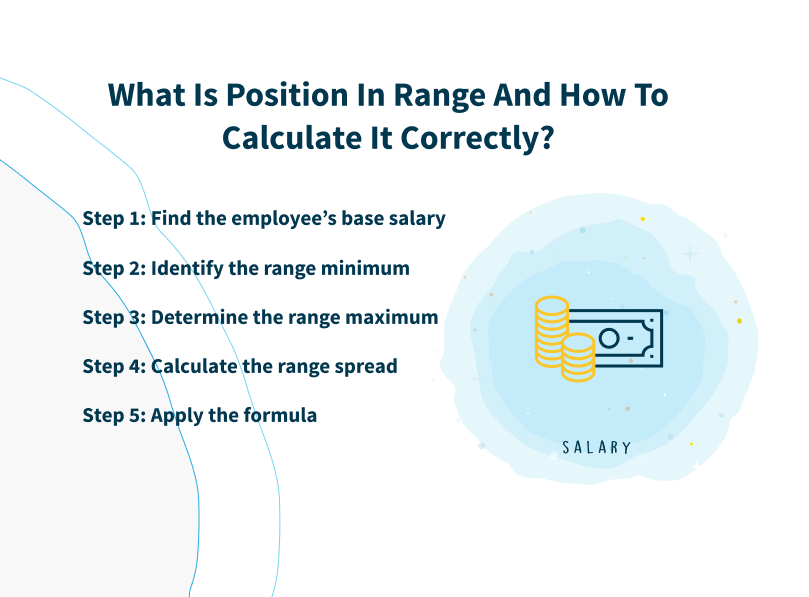
Use only the base salary. Don’t include bonuses, commissions, or other benefits. If you’re comparing employees, make sure you’re looking at the same type of pay for everyone.
For example, let’s say an employee earns $72,000.
Check the minimum salary for the employee’s pay grade. This is the lowest pay allowed for that role. If your company has different ranges for locations or job types, use the right one for that employee.
Based on the above example, the range minimum for that pay grade is $50,000.
Find the maximum salary for the same pay grade. This is the highest pay allowed for that role. For example, if the range maximum is $90,000, that’s the top of the band.
If you’re not sure whether your ranges are competitive, solutions like Salary.com's CompAnalyst Software let you compare your pay bands to current market data. This helps make sure your minimums and maximums match what’s being paid in the market.
Now subtract the minimum from the maximum to determine the full width of the pay band.
Range Spread = Maximum - Minimum
Range Spread = $90,000 - $50,000 = $40,000
This number represents how much total room exists between the floor and ceiling of the salary range.
According to the University of Colorado Boulder, the formula for calculating this range is:
Position in range (PIR) = (Employee’s Salary or Pay Rate - Range Minimum) / (Range Maximum - Range Minimum)
PIR = ($72,000 − $50,000) ÷ ($90,000 − $50,000)
= $22,000 ÷ $40,000 = 0.55
Multiply by 100 to express as a percentage: (0.55 × 100 = 55%)
This employee sits at 55% in range, which is slightly above the midpoint of their pay grade. That's generally a healthy position for a fully competent, experienced employee. It signals they're being paid fairly relative to the role, and they still have meaningful room to grow within the band before reaching the ceiling.
Here are frequently asked questions about salary range penetration:
It means the employee is being paid above the maximum of their current pay grade. This is called being “red-circled.” It often happens when pay ranges change, but the company does not lower current salaries. Employees in this situation usually do not get raises until the pay range increases to match their pay.
Position in range shows where a salary falls between the minimum and maximum. As mentioned above, 0% is the minimum, 50% is the midpoint, and 100% is the maximum.
Compa-ratio, on the other hand, compares the salary just to the midpoint, with 100% meaning it matches the midpoint exactly.
Calculate this salary range at least once a year during the annual compensation review and whenever pay ranges change. Many organizations also review it during promotion cycles and when checking pay equity.
This salary range penetration is one of the first things checked in a pay equity review. If employees in the same role and with similar skills are paid differently because of gender, race, or other factors, the difference must be explained and fixed if unfair.

The latest research, expert advice, and compensation best practices all in one place.
Blog
Bringing trusted compensation intelligence and seamless planning to even more ADP users.

Blog
Learn how to train managers for effective pay conversations and build trust.

Blog
Total rewards package flexibility lets employees choose what matters - pay, perks, and benefits tailored to their needs.