

Blog
Get Pay Right on ADP Workforce Now® Next Gen™
Bringing trusted compensation intelligence and seamless planning to even more ADP users.
Written by Salary.com Staff
April 10, 2026

With today's labor market tied more closely than ever to organizational planning from pay to retention, there is no better time to use market positioning with compensation than now. This guide will explain how it works, why it's important, and how it benefits organizations.
Market positioning in compensation refers to where an organization stands in relation to its competitors as it sets up pay plans. Should a company give more than average, equal to average, or less than average? It helps define the compensation pay plan structure alongside budgetary factors.
For example, a company might want to have 70% of compensation pay-level to be the median of the average for its competitors—for example, bonuses, salary, raises, etc.
Organizations use surveys that provide salary comparisons so companies understand where their salaries should land. This helps reduce overpayment for underwhelming value and ensures pay equity so that location, position, and industry warrant certain salaries. Therefore, It involves where pay level expectations lie and help offset compensation levels against each other to keep costs feasible.
Market positioning depends on reliable market benchmarks, structured salary ranges, and internal equity analysis. Compensation Software directly supports all these activities in one platform, making it foundational for defining and executing a market positioning strategy.
Market positioning is at the heart of any compensation strategy as it defines how pay plans will be issued. For example, if an organization wants to position itself above market averages, it will charge higher salaries to attract higher performers, but end up spending more on compensation than its competitors. If it wants to position itself below the market, it might appeal to a lower income workforce but sacrifice talent and pay equity.
Positioning impacts the compensation mix—for example, focusing on bonuses for compensation-related positions—an internal equity pay structure where similar positions within the organization receive similar benefits relative to their worth and an industry-based understanding which suggests that highly knowledge-based companies pay more attention to internal metrics for highly educated workers as opposed to market position for improved collaboration.
This study suggests that companies with creative efforts pay more attention to what they pay their workers when they offer different salaries, based on rankings and efforts for innovative projects.
Market positioning is exceptionally beneficial as it helps talent get acquired and retained. For example, if there is a competitive market and employees feel their positions deserve better pay due to their knowledge or implementation efforts, competitive positioning shows them that the organizations value their skills. Otherwise, poor positioning can result in demoralized teams who feel undervalued.
It helps pay levels stay aligned with organizational goals. If a company wants to be on the cutting edge of technology, it should retain applicants with competitive rates in tech roles. Organizations use positioning as a guiding framework so that they don't over or under budget for compensation.
Benefits |
Description |
|---|---|
Talent Acquisition |
Acquisition of skilled applicants who provide competitive rates. |
Cost Performance |
Performance of satisfied costs due to market need levels so that there is no overspending. |
Satisfaction |
Engaged workforce through trusted transparency levels as equity is respected. |
Market Positioning |
Compensation tied to organizational goals as performance (growing a workforce vs. a slowing company). |
Determine the best options based on what your organization can afford and how it positions itself against competitors. Use survey results that make sense through accurate means. For example, if your company wants to position itself as the biggest player in the game, assess your resources and your employees.
Where applicable, collaborate with other departments (budgetary, HR, leadership) to assess needs to see if practical performance can help save money needed for overzealous positioning challenges.
Explore the median range first to assess how your competitors are plugging holes and go from there; gauge economic trends (as evidenced by recent news about new budgets: 2026 indicates a 3.2% merit increase with a targeted investment spotlight).
Common positioning strategies exist within three realms; in comparison, organizations lead, lag or match the market:
Leader – Pay above average in the 75th percentile; attractive for high competitive markets like tech—better applicants come aboard.
Matcher—Pay equal to the median average of the average; around the 50th percentile—the safest option as it keeps turnover down but saves resources.
Lag—Less than average below the 50th percentile; acceptable when the organization has been around for many decades and takes a stable approach—a risk to employee retention.
Best hybrid strategies lead with the most critical roles and match the others.
Strategy Type |
Target Percentile |
Pros |
Cons |
|---|---|---|---|
Leading |
75th+ |
Attracts elites, boosts innovation |
High costs, budget strain |
Matching |
50th |
Balanced, sustainable |
May not stand out |
Lagging |
Below 50th |
Saves money |
Turnover risks, low morale |
Assess your market position through metrics like assessing compa-ratio—actual levels compared against the midpoint. This is where your percentages should average out—once again settling at 80-120%. Use turnover statistics and exit interviews as assessments as well as employee surveys to see who is satisfied and where. Compensate those who want raises and those who want additional perks annually or seasonally.
Benchmark against other organizations. Use salary surveys, salary data through the government or industry-related efforts, and findings to compile what's best. Complications should be challenged semi-annually at best—predict that in 2026, organizations will have different wage pressures relative to skilled trades which will grow more than general populations.
Compa Ratio = Employee Salary/Range Midpoint: Measure Internal Equity During Audits.
Market Penetration = Average Pay/Market Average.
Pay Equity Index: Measure Quality Equity—Internal Appeal Relative to External Gaps.
Poor positioning can be a disaster. For example, if compensation numbers are too high or too low in comparison or relative to employee expectations, turnover will be through the roof. It's easier for employees to leave for higher salaries elsewhere. Without proper pay equity, legal issues emerge as do poor-quality levels, lowering morale with those who stay who refuse to do work.
Innovation gets stunted as workers leave without their skillsets. The numbers support that companies that don't pay attention to what's inside fall short of unique revelations; those with knowledgeable efforts give more credence to internal focus efforts for patent presentations—there's a Wharton study that suggests less innovative struggle for failure; this doesn't pay attention to a cautionary approach in a data-driven world.
Recruitment costs will be higher with constant acquisition.
Productivity levels will be lower due to poor morale.
Reputation will fail in the labor market.
Implementing this strategy in your compensation program will require a data-driven approach. To successfully match or lead the market, you will need to gather extensive information about the pay practices of other organizations. Here are the steps:
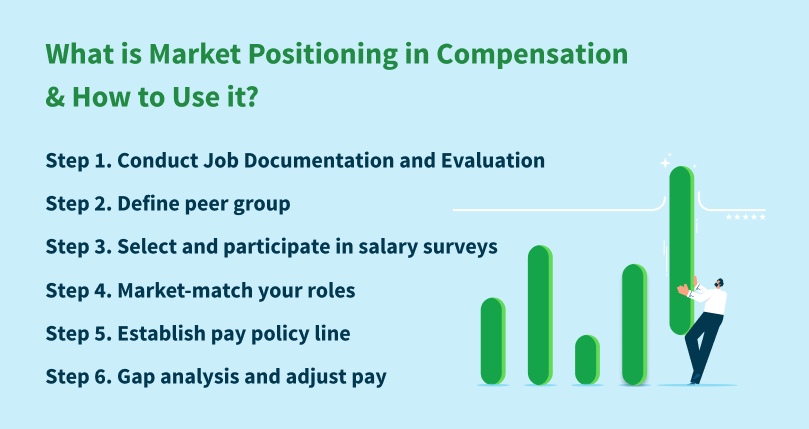
In order to implement any position strategy, you must first conduct job evaluations to determine the relative value of each job within your own organization.
Identify the organizations that compete for similar talent. It may not just be those selling the same product or service; it could be other organizations that recruit in the same geographical area from similar educational institutions.
Purchase or participate in recognized third-party salary surveys. While there is "crowdsourced" compensation data available online for free, the more reliable data are obtained from reputable sources that gather employer-reported data.
Survey Management directly supports this process by eliminating manual spreadsheet consolidation and ensuring consistent, accurate benchmarking across data sources.
Match at least 60-70% of your internal jobs to survey jobs to get a comprehensive market pay view.
Decide on your pay positioning criteria. Will you choose to pay Match, Lead, or Lag the market? Many choose to pay a hybrid, e.g., Match for administrative roles and Lead for positions with specialized skill requirements.
Compare current employee pay with established market position pay ranges. Budget to adjust pay for employees outside the salary range at your chosen market position over a specified time frame.
Here are the common questions about the topic:
Absolutely—if it's done correctly, retention will be high as competitive salaries ensure that people earn what they're worth and if they believe they're underappreciated or not compensated enough elsewhere.
Yes. Platforms like Compensation Software support real-time market benchmarking, pay structure design, and compensation analysis.
Once annually or semiannually when volatility exists; current data driven changes are through constant review; for example, in 2026 it's been reported that total increases will be 3.5%.
If average turnover rates are high or complaints arise about meetings lacking salary discussions on top of other complaints—and those goals exceed 50% of the time or salaries are low, there's little/no compa ratio and salaries are off for departments who deserve more in relation to others compared to the industry, there's a major disconnect.
It helps provide a range as people want to know what they deserve vs. what they can get; it's easier when salary negotiations come in the effort of helping an organization improve by showing others they're committed by going above compensation efforts through good salary delivery efforts, it's easier to advocate a suggestion for what needs to be done.

The latest research, expert advice, and compensation best practices all in one place.
Blog
Bringing trusted compensation intelligence and seamless planning to even more ADP users.

Blog
Learn how to train managers for effective pay conversations and build trust.

Blog
Total rewards package flexibility lets employees choose what matters - pay, perks, and benefits tailored to their needs.